
The S$45 Million AI Fund Is Here. Do You Know Your Bottleneck?
Singapore has set aside more than S$45 million over the next three years to help advanced manufacturing SMEs deploy AI solutions.
The Catalytic AI Solutions initiative, announced on 21 October by Minister of State for Energy, Trade and Industry Gan Siow Huang at the Industrial Transformation Asia-Pacific event, will offer SMEs ready-to-deploy tools for product and component design optimisation, production scheduling and predictive maintenance. Enterprise Singapore will co-fund adoption for eligible SMEs, and plans are underway to extend the initiative to the logistics and wholesale trade sectors.
For manufacturing SMEs, this is one of the more practical funding announcements in recent memory. The solutions are pre-built, the co-funding reduces the cost of entry, and the stated aim is accessibility for SMEs, not just large manufacturers.
But there is a catch, and it sits inside the business, not the grant.
The fund does not find your problem for you
A ready-to-deploy AI tool only pays off when it is pointed at a real bottleneck. Scheduling tools need clean production data. Predictive maintenance needs reliable equipment and downtime records. Design optimization needs structured product information.
This is why two SMEs can use the same funded solution and get completely different results. One has messy, scattered records and spends months just getting data into shape. The other knows its throughput numbers, downtime patterns and job costs, plugs the tool in and starts measuring gains within a quarter.
The difference is not technology appetite. It is the state of the business's operational and financial records.
Manufacturing SMEs have the most to gain, and the window is now
Manufacturing accounts for about 20% of Singapore's GDP and employs about 12% of the workforce. The national AI mission for advanced manufacturing is not a side bet. It is a coordinated push, backed by the AI Centre of Excellence for Manufacturing, which has already completed 23 deployed projects with 30 manufacturers.
Co-funding windows like this tend to favour early movers. Vendors onboard the first wave of SMEs with attention and support. Later applicants face longer queues and less hand-holding.
For an SME that has been circling AI adoption, this is the moment to stop circling. But go in with your numbers.
A practical sequence before you apply
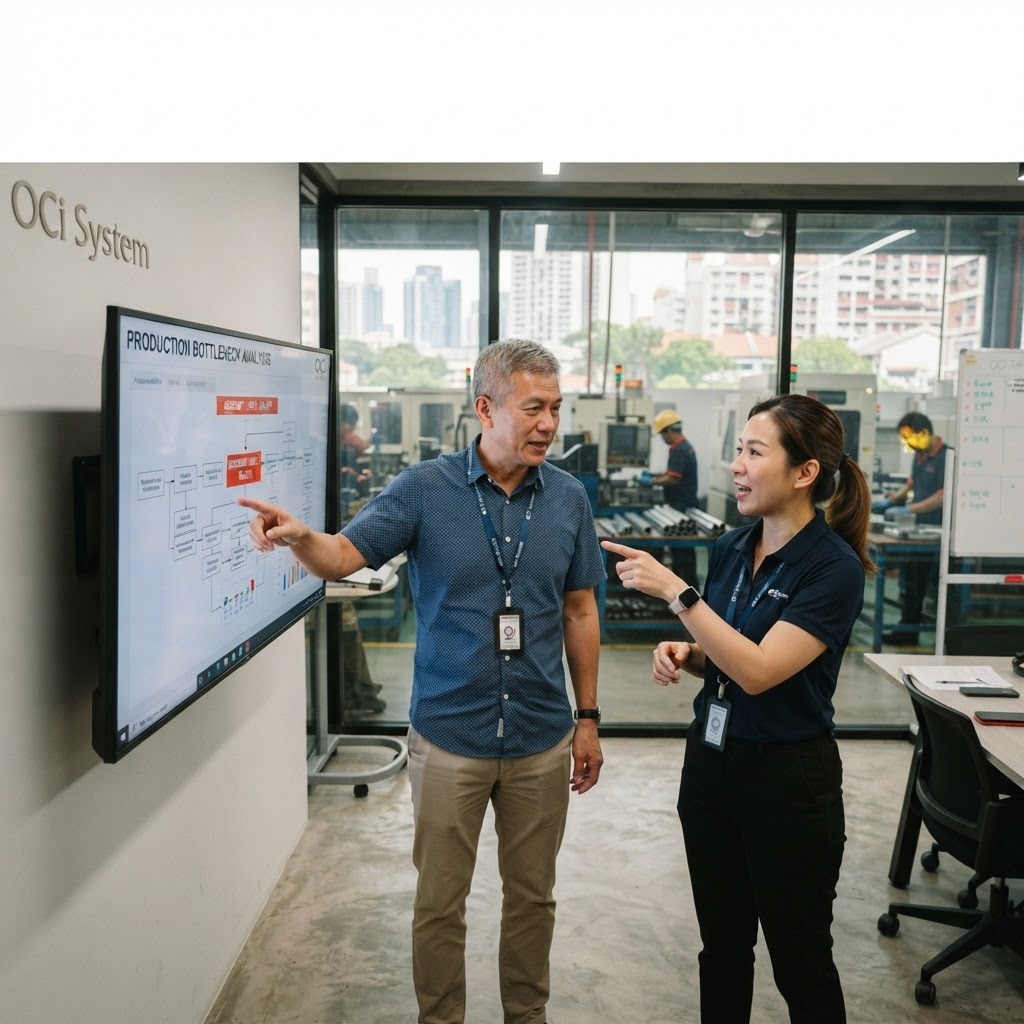
1. Name the bottleneck. Where does work pile up? Which machine, shift or process causes the most delays or rework?
2. Pull the data you have. Downtime logs, job records, scheduling sheets, cost data. What exists, and what is missing?
3. Get the financial baseline. Current output per labour hour, cost per job, inventory holding costs. This is what you will measure improvement against.
4. Match, then apply. Pick the funded solution that maps to the bottleneck you have already quantified.
Steps 1 to 3 are accounting and ERP work before they are AI work. A system that tracks jobs, costs, inventory and equipment activity in one place gives you the baseline the AI tool needs, and the scorecard that tells you whether it is working.
The short version
The money is real, the tools are ready, and SMEs are the target beneficiaries this time. The companies that gain most will be the ones whose records were ready before the fund was announced.
Source: The Straits Times, 21 Oct 2026
https://www.straitstimes.com/business/singapore-sets-aside-45m-to-help-advanced-manufacturing-smes-use-ai-solutions
2. Pull the data you have. Downtime logs, job records, scheduling sheets, cost data. What exists, and what is missing?
3. Get the financial baseline. Current output per labour hour, cost per job, inventory holding costs. This is what you will measure improvement against.
4. Match, then apply. Pick the funded solution that maps to the bottleneck you have already quantified.
https://www.straitstimes.com/business/singapore-sets-aside-45m-to-help-advanced-manufacturing-smes-use-ai-solutions